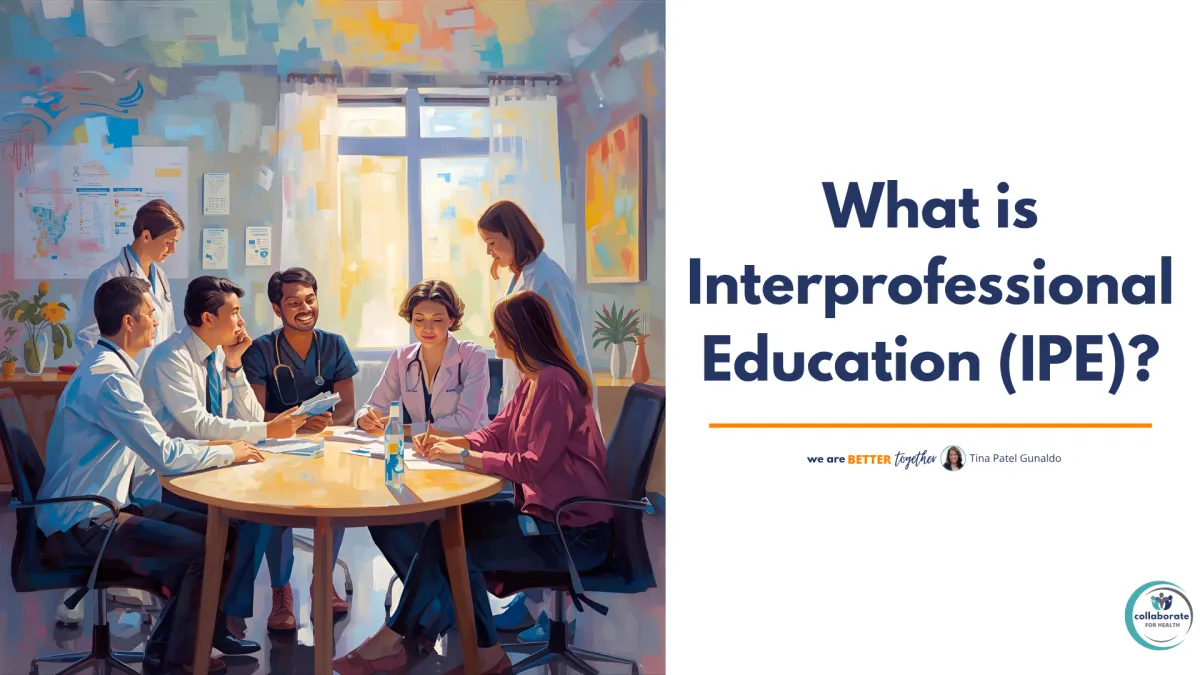
What is Interprofessional Education
Interprofessional education, commonly called IPE, is the foundation for collaborative practice in healthcare. It occurs when students or members from two or more professions learn with, from, and about each other to improve collaboration and the quality of care. Without it, health professionals enter practice having trained mostly alongside people in their own discipline, and collaboration is left to chance rather than design.
Healthcare leaders are increasingly expected to deliver system-level outcomes inside environments that were never designed for collaboration. Even when teams are capable, committed, and well-intentioned, gaps still emerge in communication, coordination, and shared expectations. These gaps are not usually the result of effort or motivation. They are the result of systems that assume collaboration will happen, rather than intentionally preparing people and structures to support it.
Collaboration does not just happen. It must be designed, practiced, and strengthened, like any other critical capability. This is the purpose of interprofessional education.
Why language and definitions matter
In my work, research, and commentary in the Journal of Interprofessional Care, I often discuss how inconsistent terminology dilutes evidence and confuses expectations. When teams use different language to describe the same concepts, collaboration becomes harder to evaluate, harder to teach, and harder to sustain.
Clear definitions allow leaders to set clear expectations, align strategy, and design systems that support collaboration rather than relying on individual effort. Words matter, especially when you are responsible for system-level outcomes. The team you name is the team you build, and the reverse is just as true. Teams that look collaborative are not always interprofessional.
How leading organizations define interprofessional education
Across organizations, the wording varies slightly. The table below shows how three leading organizations define IPE and how the definition has evolved over time.
When you compare these definitions, you can see how interprofessional education has evolved to reflect today's healthcare realities. The learner population has expanded beyond traditional students to include residents, practicing health professionals, and health workers across the system. Modern care environments, including virtual and asynchronous settings, are now part of the picture. The recognition of patients and families as partners in care has deepened.
IPE has matured from a classroom-based activity into a continuum of learning that spans the education-to-practice journey. Interprofessional collaboration is a lifelong capability, not a one-time training event.
IPE is the training ground for interprofessional collaborative practice
The World Health Organization's 2010 Framework for Action on Interprofessional Education and Collaborative Practice describes interprofessional education as a necessary step toward preparing a collaborative practice-ready health workforce. IPE is the training ground. Interprofessional collaborative practice is where that preparation becomes real in the work.
This connection matters for leaders. When health professionals enter your system having learned with, from, and about other professions, they arrive better prepared to collaborate intentionally. When they did not have that preparation, leaders are left building that foundation on the job, which takes longer and depends more heavily on individual effort and goodwill than on design.
Understanding IPE as a system-level lever positions leaders to hire more effectively, set clearer expectations for teamwork, reduce fragmentation between departments, and build the conditions for collaboration that holds beyond any single initiative.
Where to go next
This connection matters most at the point where leaders make people decisions. Hiring with interprofessional readiness in mind is one of the clearest ways this shows up in practice, since it determines whether a system is building collaboration in from the start or trying to teach it later.
For quick reference, the Resources page at collaborateforhealth.com includes a curated collection of interprofessional resources and answers to common questions about interprofessional education and collaborative practice.
Visit the Resources page here.
For a deeper foundation in the difference between team types and how interprofessional collaboration is recognized in everyday work, the free team types video is the clearest starting point available.
Watch the free team types course video here.
If you are ready to talk about what this looks like inside your specific environment, reach out.
We are better together...and better does not happen by accident.
Visit collaborateforhealth.com

