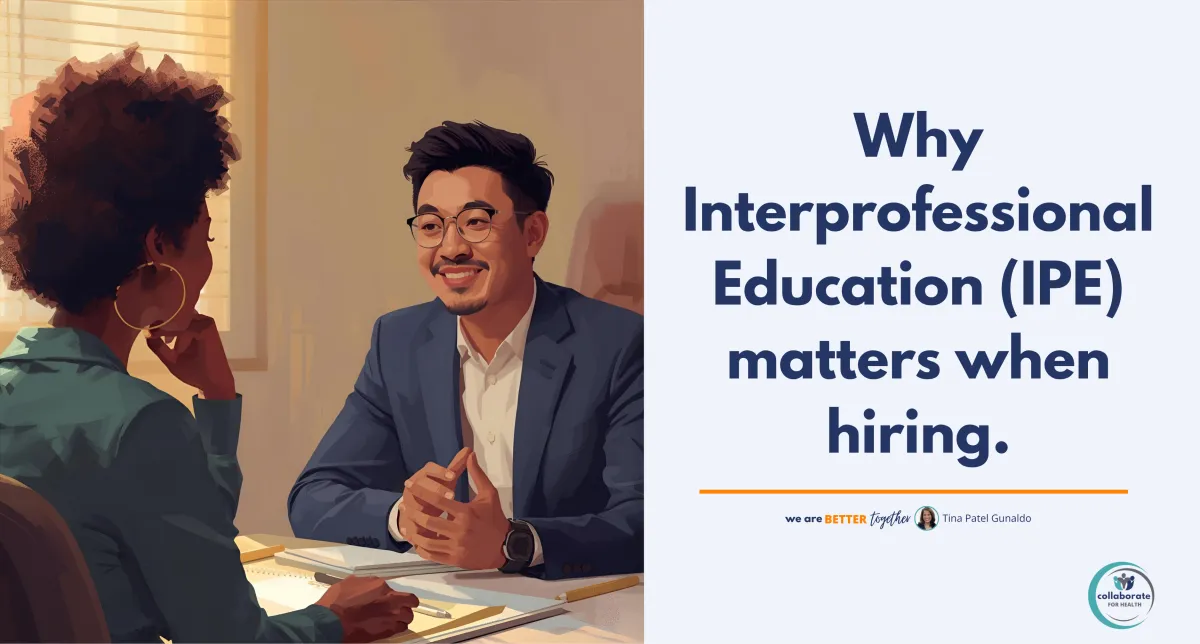
Why Interprofessional Education Matters When Hiring: Questions Healthcare Leaders Should Be Asking
Interprofessional education (IPE) prepares health professionals to be collaborative practice ready before they enter the workforce. When leaders hire individuals who already carry that preparation, they are not simply filling a position. They are shaping how collaboration will function across their department and beyond it.
If you are responsible for system-level outcomes, hiring is one of the most powerful design decisions you make. Understanding IPE and what it prepares candidates to do changes how you evaluate who belongs on your team.
If you have not yet read the foundational posts in this series, start there first.
What Is Interprofessional Education? Practical information for healthcare leaders.
What IPE Is Not: Common misconceptions healthcare leaders should know.
Hiring for collaboration is a strategic design decision
Interprofessional education exposes learners to role clarity, communication across professions, shared problem-solving, and the responsibility each profession holds in co-designing person-centered care. Professionals who enter practice with that foundation tend to look for opportunities to connect expertise rather than work in isolation. They do not simply adapt to the environment. They contribute to shaping it.
According to the U.S. Bureau of Labor Statistics, employment of medical and health services managers is projected to grow 29 percent from 2023 to 2033, much faster than average for all occupations, with approximately 61,400 openings projected each year over the decade. That growth means more candidates entering the field with formal IPE exposure than at any previous point in healthcare history. Leaders who know how to recognize and evaluate that preparation have a meaningful advantage in building teams that are ready to collaborate at the system level from the start.
Hiring for interprofessional readiness influences how smoothly new team members engage with other professions, how confidently they initiate collaboration rather than waiting to be invited, how naturally they ask questions about workflows and operations across roles, and how their interprofessional lens strengthens collaboration already present within the department.
Questions leaders should ask during the hiring process
The goal is not to test terminology. The goal is to understand how a potential team member thinks, engages, and collaborates across professions.
"Tell me about an interprofessional learning experience you participated in. What made it interprofessional, and what did you learn?"
Listen for references to learning about, from, and with other professions. If a candidate only describes being in the same room with other disciplines, the experience may not have been a meaningful interprofessional one.
"How do you understand your role in relation to other professions on a care team?"
This helps you assess their appreciation for role clarity and interdependence. Strong candidates recognize that collaboration depends on understanding both their own expertise and how it complements others.
"Describe a time you collaborated with another profession to solve a problem. What was the outcome?"
Listen for examples grounded in communication, respect, shared planning, and joint problem-solving rather than parallel work.
"How do you approach situations where your perspective differs from another profession?"
Effective interprofessional collaboration requires curiosity and openness. Defensiveness or dismissal of other perspectives often signals future challenges in team-based environments.
"How do you plan to continue developing your interprofessional skills in practice?"
Look for a commitment to ongoing learning and reflection. Interprofessional competence is not static. It develops over time and across settings.
Why this matters for healthcare leaders
Interprofessional collaboration can become part of what defines fit within your organization. As more graduates enter the workforce with formal IPE exposure, leaders have an opportunity to begin asking different questions, not only about clinical competence, but about collaborative readiness.
When you hire for interprofessional readiness, team members who already value collaboration are more inclined to participate in cross-departmental projects, quality improvement efforts, and redesign work. The buy-in is not forced. It is already present. This is Self-Authorization in practice before someone is ever formally asked. Candidates who initiate collaboration rather than wait for permission are already positioned to recognize and act on interprofessional collaborative practice once they're on your team.
Small shifts in how you hire can meaningfully influence how collaboration unfolds across your department and how prepared your team is to engage beyond it.
Where to go next
For a deeper foundation in how interprofessional collaboration is designed and sustained beyond hiring, the free team types course video is the next step.
Watch the free team types course video here.
Reach out if you are ready to talk about what this looks like inside your specific environment.
We are better together...and better does not happen by accident.
Visit collaborateforhealth.com

