What is Interprofessional Collaborative Practice? How Healthcare Leaders Can Design It Intentionally
How Leaders Can Intentionally Design Interprofessional Collaborative Practice (IPCP)
Interprofessional collaborative practice is more than multiple professions working in proximity. It is the intentional integration of professionals from different disciplines working together with patients, families, and communities to co-design care. When collaboration is left to chance, variation in outcomes increases. When it is intentionally designed, outcomes improve.
What is the official definition of IPCP?
Across organizations, the wording varies slightly. The table below shows how two leading organizations define interprofessional collaborative practice.
Both definitions name the patient, family, and community as active participants in collaborative practice, not only as recipients of it. That distinction separates interprofessional collaborative practice from multidisciplinary and interdisciplinary care. If you want to understand how these three team models differ, the post on differences in healthcare team types covers that distinction in detail.
IPCP can occur in multiple formats
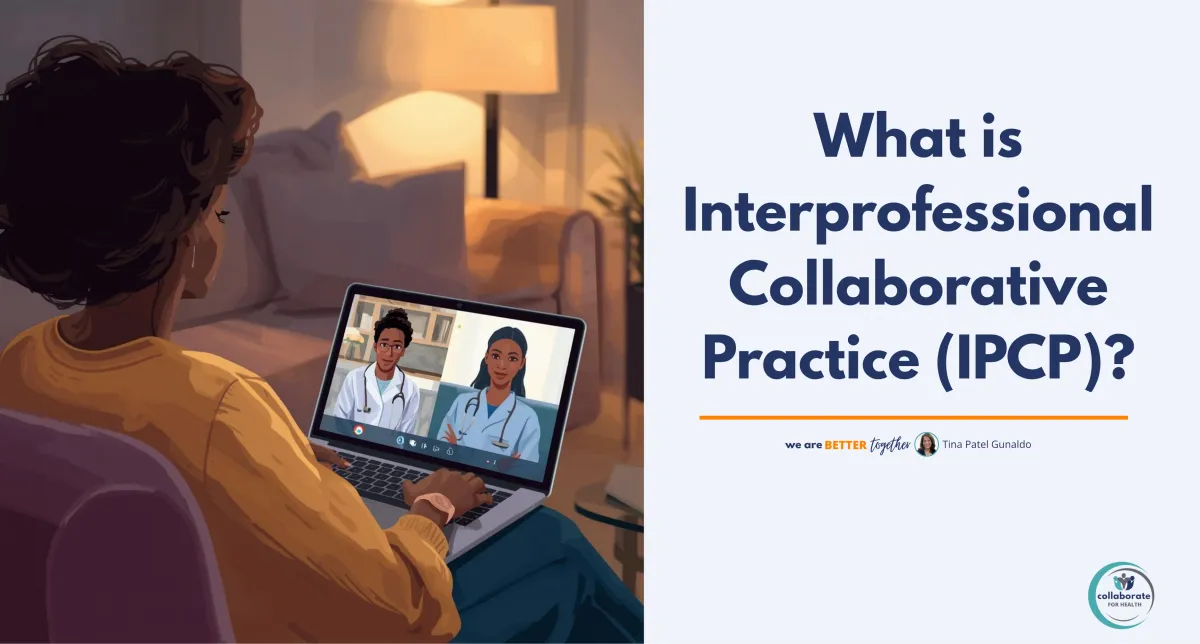
Interprofessional collaborative practice is not limited to in-person, onsite interactions. It can occur synchronously through real-time rounding or case conferences, asynchronously through coordinated documentation and shared care plans, or virtually via telehealth platforms and remote team discussions. The format is secondary to the integration. What defines IPCP is how intentionally professions align their expertise around a co-designed plan of care with the patient and their family or caregiver, not where or when that collaboration happens.
When collaboration is designed to function across formats, it becomes resilient, scalable, and sustainable.
The collaboration spectrum
Interprofessional collaborative practice develops along a continuum of integration. Collaboration is not a yes or no. It is a spectrum. The focus is not on whether collaboration exists, but on how deeply it is integrated into daily work.
At the connected level, professionals are aware of one another and referrals occur. Work remains largely individual, and collaboration depends on personal initiative rather than system structure.
At the aligned level, coordination improves. Communication becomes more intentional. Handoffs are clearer and expectations begin to stabilize across the team.
At the shared level, collaboration becomes visible. Care planning discussions involve multiple professions, and the patient or client is actively engaged. Roles are clearer and accountability is more collective.
At the designed level, the collaboration that began with individual knowledge, skills, and motivation is now embedded into the organization itself. Policies, workflows, and systems are built to support interprofessional work, so collaboration does not depend on any one team or any one leader to sustain it. Shared accountability becomes the norm rather than the exception.
This spectrum does not label one profession as more important than another. It describes the progression from individual coordination to system-supported integration. Leaders can assess where their organization currently operates and determine the next intentional step toward deeper integration.
Designing collaboration through referral systems
One practical example of designed collaboration is a referral system that allows any qualified health professional to refer directly to another appropriate profession when clinically indicated. A physical therapist may refer directly to a physician. A nurse may initiate a referral to a speech-language pathologist. A pharmacist may recommend consultation with a nurse practitioner. A social worker may initiate a referral to a community health worker.
When referral pathways are built into the workflow this way, collaboration becomes embedded into the system rather than dependent on personal relationships or individual initiative.
The connection between IPE and IPCP
Interprofessional education is the training ground for interprofessional collaborative practice. IPE prepares learners to collaborate. IPCP is where those skills are applied and sustained in practice environments.
The National Academies of Practice definition makes this explicit, describing IPCP as "an extension of interprofessional education into practice environments." When IPE and IPCP are aligned, leaders are no longer compensating for gaps in preparation. They are building on a shared foundation of collaborative competence.
If you have not yet read the companion posts in this series, they provide the foundation for understanding how professionals become collaborative practice ready.
What Is Interprofessional Education? Practical information for healthcare leaders.
What IPE Is Not: Common misconceptions healthcare leaders should know.
Why this matters for healthcare leaders
Leaders who understand IPCP as a design challenge rather than a relationship challenge are positioned to build something more durable than goodwill-based collaboration. They can examine how referrals flow, how care plans are co-created, how accountability is shared, and how their team's everyday work connects to a larger system of care.
The outcomes of designed IPCP are measurable. A 2019 study published in the Annals of Family Medicine examining an IPCP model implemented within a family medicine residency and ambulatory care center found that high-risk patients experienced 16.7 percent fewer emergency department visits, 17.7 percent fewer hospitalizations, a 0.8 percent reduction in hemoglobin A1c levels, and a 48.2 percent reduction in total patient charges. These results did not come from adding more professionals to the team. They came from designing how those professionals worked together.
Collaboration that is intentionally designed produces outcomes that no single department can claim independently. That is what makes it visible at the system level, and that is what makes the leaders who design it visible too.
Where to go next
For a deeper look at how interprofessional collaborative practice shows up in everyday clinical work, including how to recognize it in referrals, documentation, and team interactions, the IPCP in Everyday Work video walks through real examples from practice.
Access the IPCP in Everyday Work video here.
For a quick reference on common questions about IPE and IPCP, the Resources page includes a curated FAQ section.
Visit the Resources page here.
Reach out if you are ready to talk about what this looks like inside your specific environment.
We are better together...and better does not happen by accident.
Visit collaborateforhealth.com

