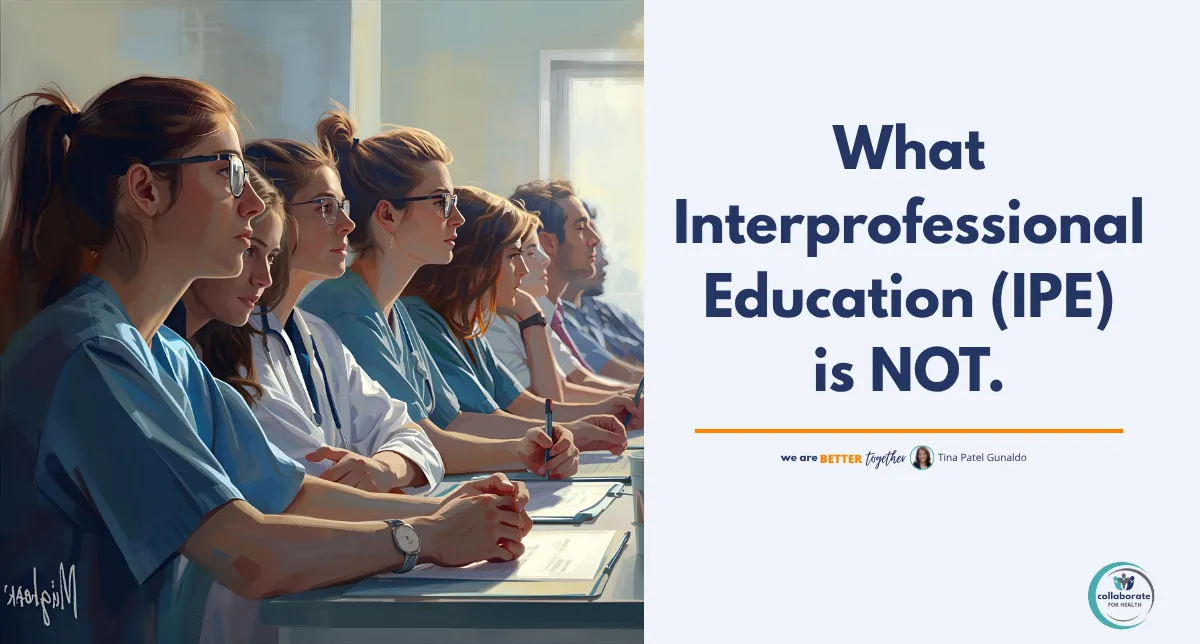
What Interprofessional Education Is Not: Common Misconceptions Healthcare Leaders Should Know
Proximity does not equal interprofessional learning, and exposure does not create collaboration. Many organizations believe they are offering interprofessional education (IPE) simply because multiple professions are present in the same classroom, workshop, or continuing education session. That assumption leads to programs that look collaborative on the surface but fail to prepare learners for real-world teamwork.
Understanding what IPE is not is just as important as understanding what it is. Without that clarity, leaders risk investing in education that does not meet the definition and does not produce the results they are expecting.
As I discuss in my work and research in the Journal of Interprofessional Care, words matter. When activities are labeled as IPE but do not meet the definition, expectations are diluted, outcomes are weakened, and learners are confused when they are later asked to collaborate in complex practice environments.
IPE is not unidirectional or passive learning
Placing learners from different professions in the same course or conference does not automatically make the experience interprofessional. A one-way lecture is not IPE. Sitting together without interaction is not IPE. In both cases, multiple professions are present. Neither experience qualifies as IPE. This same distinction, presence versus design, is what separates a multidisciplinary team from a true interprofessional one.
Two examples that illustrate this distinction:
A lecture on body mechanics attended by nursing, occupational therapy, and physical therapy students with no planned interaction between them. A concussion conference attended by speech-language pathologists, audiologists, neurosurgeons, and athletic trainers without structured collaboration built into the session.
In both cases, multiple professions are present. Neither experience qualifies as IPE.
For an experience to qualify, learners from different professions must interact. They must exchange perspectives, contribute their professional expertise, and learn with, from, and about one another. Without active, bidirectional engagement, the learning remains multidisciplinary, not interprofessional.
IPE is not one profession teaching another
When one profession delivers content to another in a one-way format, the experience can be valuable. It is not IPE.
Examples include pharmacists teaching nurses about medication formulations, physicians teaching athletic trainers about concussion management, and physical therapists teaching nursing students about body mechanics. These sessions strengthen discipline-specific knowledge and may support future interprofessional learning. On their own, they do not meet the definition of IPE.
Interprofessional education requires mutual participation, shared problem-solving, shared understanding of professional roles, and shared respect for expertise. One profession teaching another is an important educational strategy. It should not be mislabeled as interprofessional education.
IPE is not simply involving multiple professions
Interprofessional education is not achieved by adding more professions to a room or a program. It requires intentional design, active engagement, shared decision-making, and meaningful exchange across roles.
Most importantly, interprofessional learning is most effective when it is patient-centered, client-centered, or community-centered. Whether the learning is built around a written case, a simulated patient, or a real person and family, the purpose is to understand how the team collaborates to deliver person-centered care, not how professions operate in parallel.
The design of the learning experience, not the number of professions present, determines whether it qualifies as IPE.
Why this matters for healthcare leaders
Leaders are often the ones endorsing IPE initiatives, approving training budgets, and hiring educators and consultants. This is especially true for department-level leaders, since interprofessional education is now a formal accreditation requirement across the field. The Health Professions Accreditors Collaborative (HPAC), founded in 2014 by six accrediting bodies, has grown to 25 member organizations that address IPE in their standards. That growth signals how central interprofessional preparation has become to how health professions are trained, and it raises the stakes for leaders who need to know their teams' education actually meets the definition, not just the appearance, of interprofessional learning. When those leaders understand what IPE is not, they can ensure the education delivered in their organization reflects the true intent of interprofessional collaboration.
When teams believe they are doing IPE when they are not, organizations risk presenting inaccurate information to staff, creating inconsistent expectations across departments, weakening efforts to build high-performing collaborative teams, reinforcing siloed thinking unintentionally, and investing in programs that do not prepare learners for real-world teamwork.
The same misconception shows up beyond the classroom. An initiative can look collaborative without being interprofessional, which means leaders need this distinction just as much once training ends and the real work begins. Clarity protects your teams. It strengthens culture. It ensures you are building a workforce prepared to collaborate confidently and consistently.
Where to go next
If you have not yet read the companion post, start there first.
What is Interprofessional Education? Practical information for healthcare leaders.
For a deeper foundation in how the three team types differ and where interprofessional collaboration fits in everyday work, the free team types video is the clearest next step.
Watch the free team types course video here.
Reach out if you are ready to talk about what this looks like inside your specific environment.
We are better together...and better does not happen by accident.
Visit collaborateforhealth.com

