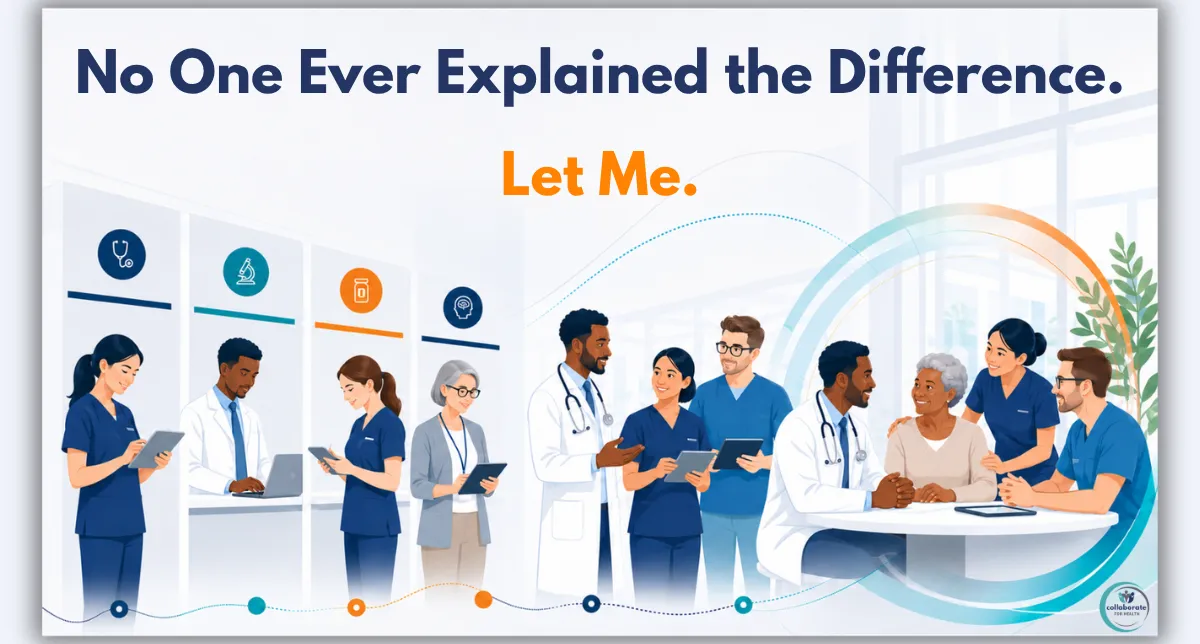
Differences in Healthcare Team Types: Multidisciplinary, Interdisciplinary, and Interprofessional Explained
Multidisciplinary, interdisciplinary, and interprofessional are not interchangeable terms. Each describes a fundamentally different level of integration, a different structure of shared decision-making, and a different relationship with the patient and family in the care process. Understanding those differences is where intentional team design begins.
Where the confusion comes from
For years I worked in healthcare using whatever term was most familiar. Multidisciplinary in school. Interdisciplinary in practice. Interprofessional came later. Nobody sat me down and explained the difference. I learned it by specializing in the field, asking why constantly, digging into the research, and observing what I saw around me in manuscript submissions I was reviewing, in journal articles I was reading, and in conference presentations where I kept noticing that people were using all three terms interchangeably.
What struck me most was that this was happening not just anywhere. It was happening in our interprofessional journals and at our interprofessional-focused conferences. That is when I knew we needed clarity around this. That observation is what eventually led me to write about it, and it is what led me to write this.
What each team type actually means
A multidisciplinary team is one where professionals from different disciplines contribute their expertise independently. Each person works within their own lane, and patients or clients receive input from multiple professions. The contributions are additive but not integrated.
An interdisciplinary team is better coordinated. There is more communication and awareness of what other professions are contributing, and team members understand each other's roles. Each profession still largely leads within its own domain, but the coordination is more intentional.
An interprofessional collaborative practice (IPCP) team is intentionally designed for full integration. Professions shape the work collaboratively. Shared decision-making, shared accountability, and a shared relationship with the patient and family as active participants in care are built into how the team functions. This does not happen naturally or by goodwill alone. It is designed intentionally, supported structurally, and built on a foundation of interprofessional education (IPE).
Why this is not just a matter of semantics
You get the results you design for.
A 2019 study published in the Annals of Family Medicine examining an IPCP model implemented within a family medicine residency and ambulatory care center found that high-risk patients experienced 16.7 percent fewer emergency department visits, 17.7 percent fewer hospitalizations, a 0.8 percent reduction in hemoglobin A1c levels, and a 48.2 percent reduction in total patient charges. Those results came from a team designed for full integration, not from parallel contributions assembled at the end.
Each team type also requires a different level of knowledge, skills, behaviors, and motivation from the people within it. A multidisciplinary team requires each profession to contribute independently and competently within its own domain. An interdisciplinary team requires coordination and communication across professions. An interprofessional team requires a shared approach, the development of an interprofessional identity, and the structured conditions that make full integration possible.
When you understand those differences, you can design intentionally. Whether you are building a curriculum that prepares students for interprofessional practice, leading a team and shaping the environment that makes collaboration possible, or working on the frontline and trying to understand what your team is designed to achieve, knowing what each team type requires changes how you show up and what you are able to build.
This is not about which team type is better. It is about being clear on what you are designing, what it requires, and whether the knowledge, skills, behaviors, and structures around you are aligned with that intention.
Where to go next
If you are new to this language or need clarity, the free team types video walks through all three team types, their similarities, and their differences. It is the clearest starting point for anyone doing this work regardless of where they are beginning.
Watch the free team types video here.
If you are an educator looking for a structured resource, the second edition of our interprofessional education and collaborative practice textbook begins in Chapter 1 with exactly this content, because we believe it is the foundation of everything that follows in IPE and IPCP.
Explore the courses and resources page here.
If you are part of a health system education or professional development team looking for resources to support your interprofessional work, the IPCP in Everyday Work video is a strong next step.
Access the IPCP in Everyday Work video here.
For the companion posts in this series, start here.
What is Interprofessional Collaborative Practice?
Your Initiative May Be Collaborative. That Does Not Mean It Is Interprofessional.
Reach out if you are ready to talk about what this looks like inside your specific environment.
We are better together...and better does not happen by accident.
Visit collaborateforhealth.com

