Curated Resource Hub

INTERPROFESSIONAL EDUCATION AND COLLABORATIVE PRACTICE RESOURCES

The only health professional-facing hub bringing together journals, organizations, conferences, and foundational reports in one place curated by a healthcare leader with 15 years in interprofessional education and collaborative practice.

What is interprofessional education (IPE)?

Interprofessional education occurs when health professionals from two or more professions learn about, from, and with each other to improve collaboration and the quality of care. It is the foundation for building teams that can solve complex health challenges no single profession can address alone. Learn more about what IPE is and what IPE is not.

What is interprofessional collaborative practice (IPCP)?

Interprofessional collaborative practice is what happens when multiple health professions work together with patients, families, and communities to deliver the highest quality of care. It is not automatic. It must be intentionally prepared, designed, and sustained to produce measurable outcomes. Learn more about what IPCP is and what IPCP is not.

What are the IPEC core competencies for interprofessional collaborative practice?

The Interprofessional Education Collaborative (IPEC) core competencies define the knowledge, skills, values, and attitudes required for effective interprofessional collaborative practice. First published in 2011 and updated in 2016, the most current version, Version 3, released in November 2023, retains the overarching competency domain of interprofessional collaboration and organizes 33 sub-competency statements under four competency areas: values and ethics, roles and responsibilities, communication, and teams and teamwork.

The competencies provide a blueprint for how to prepare learners at any stage in their health professional journey. They serve as the national framework for health professions education programs and are increasingly referenced by health systems designing team-based care. a

What is the difference between multidisciplinary, interdisciplinary, and interprofessional?

These terms are often used interchangeably but they describe fundamentally different levels of integration. Multidisciplinary means each profession contributes independently, with work placed side by side but little coordination across disciplines. Interdisciplinary involves more intentional coordination planned in advance, but contributions remain somewhat separate. Interprofessional means every contribution is intentionally connected, roles are shared, and outcomes are jointly owned across professions. This is where collaboration is designed rather than assumed. Want to see these concepts in action? Watch a free video on the difference between multidisciplinary, interdisciplinary, and interprofessional collaboration.

What does interprofessional collaboration look like from a patient and family perspective?

Interprofessional collaborative practice is not about placing patients and families at the center of care. It is about walking alongside your care team, hand in hand, as an active and equal participant in every decision that affects your health and wellbeing. The phrase "nothing about me without me" captures this perfectly. Your voice is not consulted after decisions are made. It shapes them from the beginning.

When a true interprofessional collaborative practice team is functioning well, patients and families are actively co-designing their care alongside health professionals and community-based professionals whose expertise is relevant to their lives. That team extends beyond the walls of a clinic or hospital. Interprofessional collaborative practice recognizes that health outcomes are shaped by the full context of a person's life, which means the right team might include educators, social workers, law enforcement, or community organizations alongside traditional health professionals.

Communication flows in both directions. Health professionals bring their expertise. Patients and families bring their lived experience, their values, and their priorities. Neither is more important than the other. Together, that exchange produces the information needed to make the best possible decisions for yourself and your family. You are not managed. You are not spoken for. You are recognized as the leader of your team.

What are the leading interprofessional education & interprofessional collaboration journals?

Peer-reviewed journals are the gold standard for evidence in the field. The journals below focus specifically on interprofessional education and collaborative practice. For broader searches, use PubMed® or Google Scholar.

Interprofessional education and collaborative practice journals

Patient-centered care journals

While these journals are not exclusively interprofessional, they are included here because interprofessional collaborative practice should always be patient-centered. Understanding the patient and family perspective is foundational to designing collaboration that produces meaningful outcomes.

What organizations support interprofessional education and interprofessional collaboration?

These are the national and global organizations actively advancing IPE and IPCP. Profession-specific associations are not included below. This list focuses on organizations whose primary mission is interprofessional.

Member organizations

National organizations

International organizations

Patient-centered organizations

Where can health professionals find interprofessional education and interprofessional collaboration conferences?

These are the primary conference venues where interprofessional education and collaborative practice are the focus, not a side track, but the main event. Whether you are a community member, patient, clinician, educator, researcher, or a health system leader, these gatherings are where the field comes together.

Regional conferences

National conferences

International conferences

Patient-focused conferences

  • Coming soon

What are the most important interprofessional education reports and frameworks?

These foundational documents from national and international bodies define the evidence base for interprofessional education (IPE) and interprofessional collaborative practice (IPCP). They represent the most widely cited frameworks and research summaries in the field. They are essential reading for health professionals, educators, and health system leaders designing collaboration that produces measurable outcomes. Whether you are building a case for interprofessional work in your organization or deepening your own understanding of the evidence, these reports are the starting point.

National reports

International reports

Frequently Asked Questions

What interprofessional education courses are available for health professionals outside of a degree program?

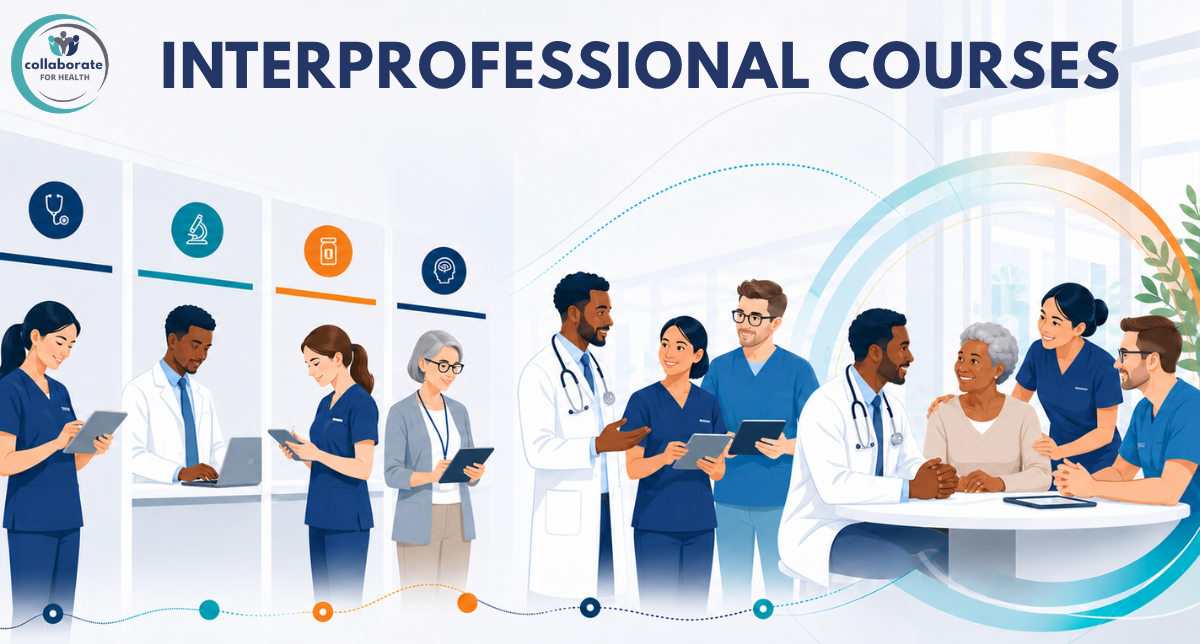
Collaborate for Health offers online courses designed for health professionals and educators at any stage of their interprofessional journey. No degree program is required. Currently available are two foundational courses: The Difference Between Multidisciplinary, Interdisciplinary, and Interprofessional Teams, a guide for healthcare leaders and educators to clarify team models and strengthen collaborative practice, and Asynchronous Interprofessional Collaborative Practice. Additional courses are coming soon.

Are there consulting services for interprofessional education program development?

Health systems and educators looking to strengthen interprofessional education within their programs and curricula are welcome to reach out to explore how Collaborate for Health can support that work. Areas of focus include integrating interprofessional education intentionally into existing curriculum, starting with the foundational anatomy of communication and teamwork before weaving in interprofessional competencies, incorporating interprofessional facilitation questions into simulation debriefs, and designing learning experiences that recognize interprofessional collaborative practice as self-directed and asynchronous rather than dependent on synchronous team events. If you are looking for a keynote speaker or a thought partner for your interprofessional education initiatives, schedule a call to start the conversation.

What are examples of interprofessional education in healthcare?

One of the most common examples in health systems is simulation, where health professionals from two or more professions practice together in safe environments designed to improve quality outcomes. The space or equipment is not what makes the experience interprofessional. What makes it interprofessional is the intentional focus on communication, values, roles, and teamwork among the professions involved.

How the experience is designed matters as much as the activity itself. A well-designed interprofessional education experience begins with a clear learning goal and includes a structured debrief afterward. Facilitated questions focused on interprofessional competencies help the team reflect on what they learned about each other's roles, how they communicated, and how to apply that learning to improve collaboration in their everyday work.

What are the benefits of interprofessional collaboration in healthcare?

The benefits of intentionally designed interprofessional collaboration are wide-ranging and directly support the Quintuple Aim, improving patient experience, advancing population health, reducing costs, improving the work life and wellbeing of health professionals, and advancing health equity. These benefits do not emerge from goodwill or proximity alone. They require structured, evidence-informed interprofessional collaborative practice. When collaboration is designed rather than assumed, health systems see measurable improvements across all five dimensions of the Quintuple Aim.

How is interprofessional collaboration different from teamwork?

Teamwork often describes people working together in temporary groups without structured planning or intentional design. Interprofessional collaboration is fundamentally different. It involves two or more professions working together in ways that are intentionally planned and supported by the environment, context, and available resources. That collaboration can be synchronous or asynchronous, and when designed well it becomes an embedded habit within the culture of a team or health system rather than a one-time effort. The IPEC Teams and Teamwork competency provides specific behavioral expectations that define what interprofessional collaboration looks like in practice, going well beyond the general concept of people working toward a shared goal.

Resources to Facilitate Interprofessional Education Experiences

These patient stories and documentaries are powerful teaching tools for interprofessional education experiences. They illustrate what happens to patients and families when interprofessional teams work well together and when they do not. Each resource can anchor meaningful discussion about collaboration, communication, and shared accountability across professions. Facilitation questions are available to guide interprofessional learning conversations around each resource.

Positive Experiences

Negative Experiences

2023-2026 Collaborate for Health. All Rights Reserved