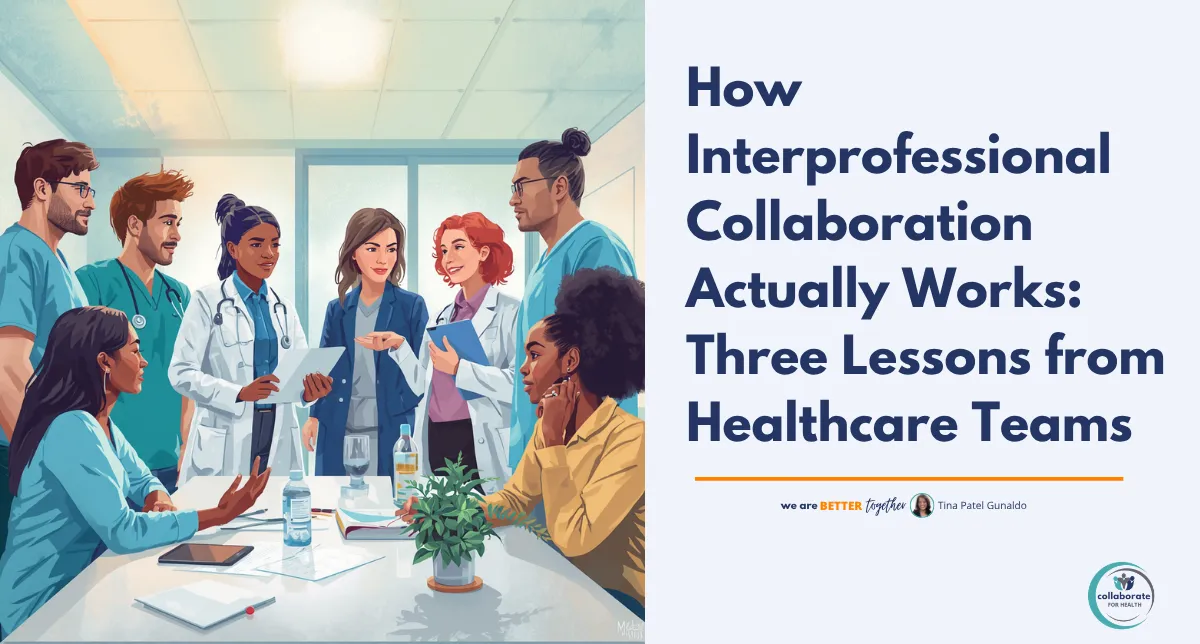
How Interprofessional Collaboration Actually Works: Three Lessons from Healthcare Teams
Interprofessional collaboration in healthcare looks different in practice than most people picture it. It is not always a formal team meeting, a structured case conference, or a room where every profession is present at the same time. It is often quieter, more distributed, and more dependent on individual initiative than the textbook version suggests.
This year I had the privilege of walking into six different rooms to talk about interprofessional education and collaborative practice. Each room brought together a different organization, a different mix of professions, a different setting, and a different level of experience with interprofessional work. Three lessons came out of those conversations that are worth continuing beyond the rooms where they started.
Lesson 1: If the system has not invited you to the table, invite yourself
In two separate engagements, someone raised their hand and asked a version of the same question. One came from someone in public health. The other came from a chaplain. Both were asking how they could be more visible at the interprofessional table. How do we get people to notice us? How do we become part of the team?
Two different rooms, two different professions, one question that revealed something important about where the interprofessional field still has work to do.
My answer was a reframe. If the system has not invited you to the table, invite yourself. Do not wait for recognition to arrive. If you believe your expertise would strengthen the team and improve the experience of the patient or community you serve, ask to be part of the work.
That bidirectional energy, not just waiting to be included but actively seeking to contribute, is itself an interprofessional act. The best interprofessional teams are not built by systems alone. They are built by individuals who understand the value of coming together and who are willing to ask for a seat at the table even when one has not been offered.
This is what self-authorization looks like in practice. It is not self-promotion. It is showing up with something specific and relevant to offer, in the language of the people you want to work alongside, before you are formally invited to do so.
Lesson 2: Shared language is not just terminology. It shapes what we build.
Regardless of the setting, the need for clarity around the differences between multidisciplinary, interdisciplinary, and interprofessional teams came up in every conversation. This was true whether someone was new to the interprofessional space or had been working in it for years.
The terms are still being used interchangeably and the confusion is slowing down the advancement of the field. Each term describes a fundamentally different team structure, a different level of integration, and a different relationship with the patient, client, or community member. When we use them interchangeably, we lose the precision the field needs to advance.
Shared language is not just a matter of terminology. It shapes what we build, what we teach, and what we are able to sustain. The team you name is the team you build.
If you want a clear foundation for understanding the differences between these three team models, the free team types video provides clarity on the differences and similarities between all three models.
Watch the free team types video here.
Lesson 3: Interprofessional practice is as much asynchronous as it is synchronous
The consistent realization across every room was that interprofessional collaborative practice does not require everyone to be in the same room at the same time. For many in the room, this brought a new level of clarity and expanded what they thought was possible within their own setting.
When people recognize that interprofessional practice can happen through coordinated documentation, structured referrals, shared care plans, and intentional handoffs, the possibilities for how it can be practiced expand significantly. Interprofessional practice falls on a spectrum. It is not always going to look the way we picture it, and it starts with the individual.
Consider what you can do, in your role, on your shift, and in your setting, to begin engaging in interprofessional collaborative practice in the everyday work that is already happening around you.
That question is the focus of the IPCP in Everyday Work course, which walks through real clinical examples of asynchronous interprofessional practice and how to recognize and build on it intentionally.
Access the IPCP in Everyday Work course here.
What the conversations taught me
These conversations gave me the opportunity to bring insight to a topic I care deeply about, and equally the opportunity to learn from every person in every room who brought their own lens, their own experience, and their own questions to the conversation.
That bidirectional learning is interprofessional practice lived in real time.
If you are newer to the concepts of interprofessional education and interprofessional collaborative practice, the following posts in this series provide the foundation.
What is Interprofessional Education?
What Interprofessional Education Is Not.
What is Interprofessional Collaborative Practice?
What Interprofessional Collaborative Practice Is Not.
To explore both courses and additional resources, visit the Courses page.
Reach out if you are ready to talk about what this looks like inside your specific environment.
We are better together...and better does not happen by accident.
Visit collaborateforhealth.com

