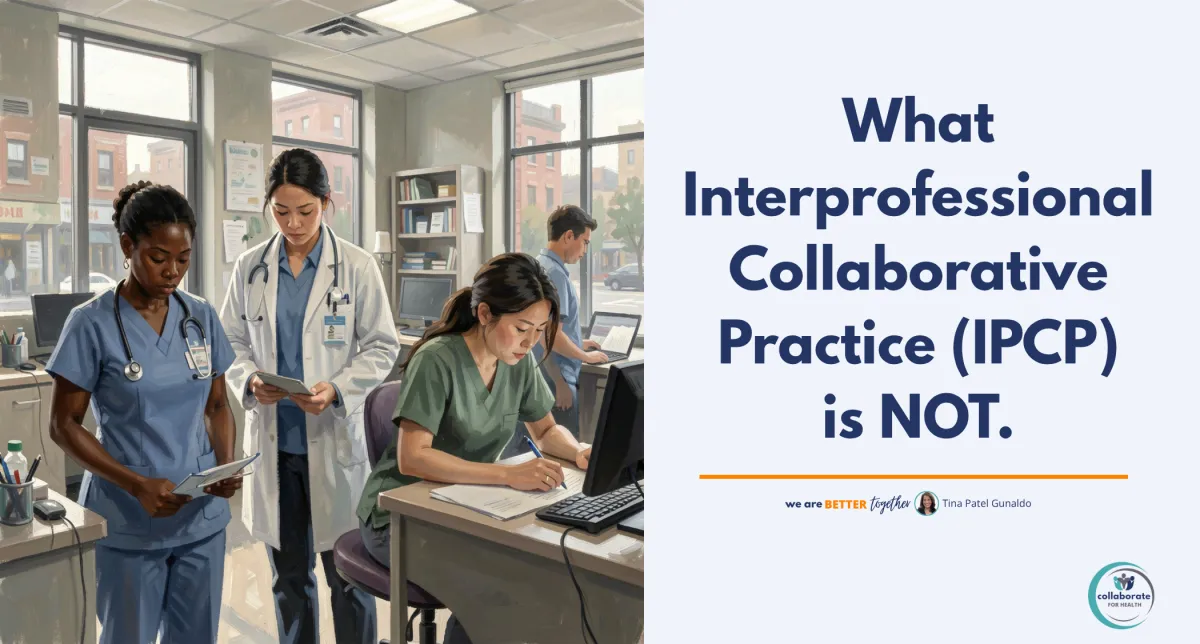
What Interprofessional Collaborative Practice Is Not: Common Misconceptions Healthcare Leaders Should Know
Interprofessional collaborative practice (IPCP) is not defined by who is present in the room. It is defined by how care is integrated. Many organizations believe they are practicing IPCP simply because multiple professions are involved in care, and that assumption leads to initiatives that appear collaborative but do not actually integrate expertise across professions.
Understanding what IPCP is not is just as important as understanding what it is. Without that clarity, leaders risk investing in work that does not produce the outcomes interprofessional collaborative practice is designed to achieve.
IPCP is not multiple professions working near each other
Many clinical environments include multiple professions in the same hallway, clinic, or unit. That does not automatically mean collaborative practice is occurring.
If each profession completes their work independently and care is coordinated only through occasional updates, the work may be multidisciplinary, but it is not interprofessional collaborative practice. IPCP requires intentional integration around a shared plan of care, not simply shared space.
IPCP is not parallel care plans
A common pattern in healthcare is parallel work. Each profession assesses the patient. Each profession documents. Each profession makes their own recommendations.
IPCP is not independently developed care plans stitched together at the end. Collaborative practice occurs when professions intentionally coordinate their expertise around a shared plan of care. Integration can occur synchronously, asynchronously, virtually, or onsite. The defining feature is not timing or location. It is how intentionally professions align their expertise around a shared goal with the patient and family.
IPCP is not a meeting about the patient
Teams sometimes assume collaboration has occurred simply because a case conference or team meeting took place. A meeting is not IPCP.
Collaborative practice is strongest when the patient or caregiver is present so that care can be co-designed together. When the patient or caregiver cannot participate directly, their perspective should still be represented. A team member may bring the patient's voice forward or intentionally serve as a patient advocate within the discussion.
In interprofessional collaborative practice, the goal is not simply to discuss the patient. It is to design care with the patient.
IPCP is not one profession directing the work of others
In many settings, decision-making still follows traditional hierarchies. Leadership and accountability are important, but IPCP is not achieved when one profession holds the care plan and others simply execute tasks.
Collaborative practice requires mutual contribution, shared respect for expertise, and space for each profession to bring forward what they see, know, and recommend. In IPCP, professional roles are not blurred. They are clarified and optimized.
IPCP is not personality-driven collaboration
Many teams collaborate well because certain individuals are naturally relational, proactive, or strong communicators. That kind of collaboration can be meaningful, but it is difficult to sustain when it depends primarily on personality.
At its best, IPCP is not accidental. It is designed. When collaboration is intentionally designed into workflows and expectations, teams are better able to coordinate expertise, engage patients and families, and sustain collaboration across settings and over time.
Why this matters for healthcare leaders
Each of these misconceptions points to the same underlying issue: collaboration that looks interprofessional on the surface but was never intentionally designed to function that way. Leaders who can recognize the difference are better positioned to evaluate what is actually happening in their teams, set accurate expectations, and invest in approaches that produce real integration.
The outcomes of designed IPCP are measurable. A 2019 study published in the Annals of Family Medicine examining an IPCP model implemented within a family medicine residency and ambulatory care center found that high-risk patients experienced 16.7 percent fewer emergency department visits, 17.7 percent fewer hospitalizations, a 0.8 percent reduction in hemoglobin A1c levels, and a 48.2 percent reduction in total patient charges. Those results came from designed collaboration, not from proximity, parallel care plans, or personality-driven effort.
Where to go next
If you have not yet read the companion post, start there first.
For a deeper look at how interprofessional collaborative practice shows up in everyday clinical work, the IPCP in Everyday Work video walks through real examples from practice.
Access the IPCP in Everyday Work video here.
For a quick reference on common questions about IPE and IPCP, the Resources page includes a curated FAQ section.
Visit the Resources page here.
Reach out if you are ready to talk about what this looks like inside your specific environment.
We are better together...and better does not happen by accident.
Visit collaborateforhealth.com

