BLOG
What Interprofessional Education Is Not
Common misconceptions healthcare leaders should know
As healthcare leaders place greater emphasis on collaboration, many organizations believe they are offering interprofessional education simply because multiple professions are present in the same classroom, workshop, or continuing education session.
But proximity does not equal interprofessional learning. And exposure does not create collaboration.
Understanding what interprofessional education (IPE) is not is just as important as understanding what it is. Without that clarity, leaders risk investing in education that looks collaborative on the surface but fails to prepare learners for real-world teamwork.
As I often emphasize in my work and research, words matter. When activities are labeled as IPE but do not meet the definition, expectations are diluted, outcomes are weakened, and learners are confused when they are later asked to collaborate in complex practice environments.
To support clarity and alignment, below are some of the most common misconceptions leaders should recognize.
1. IPE is not unidirectional or passive learning
Placing learners from different professions in the same course or conference does not automatically make the experience interprofessional.
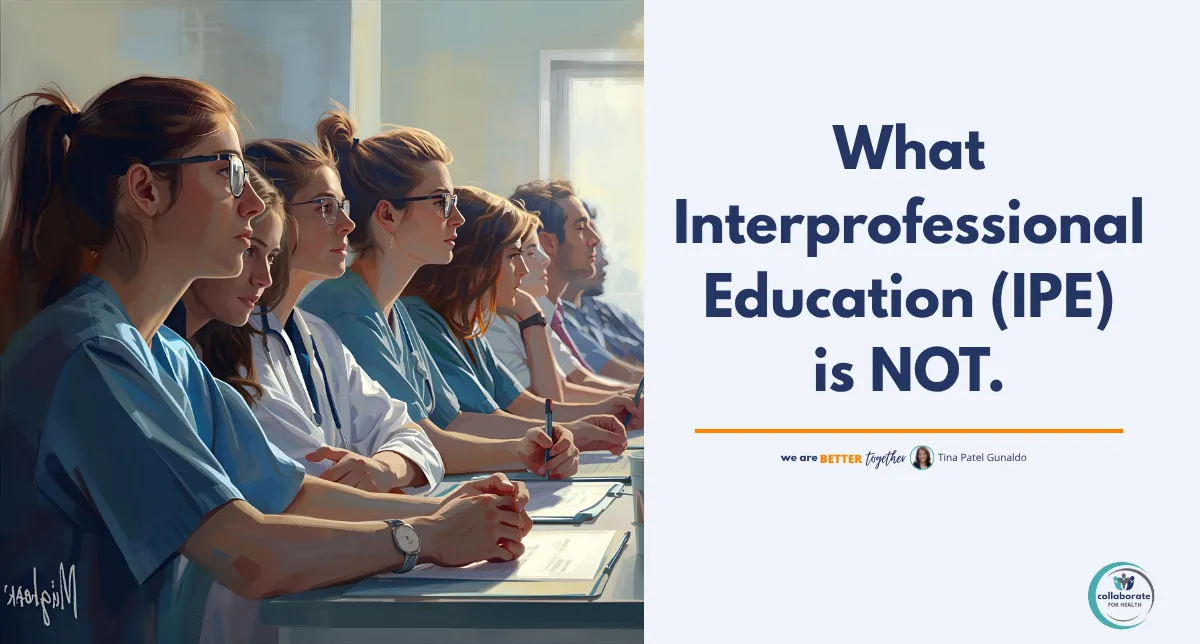
A one-way lecture is not IPE. Sitting together without interaction is not IPE.
Examples include:
A lecture on body mechanics attended by nursing, occupational therapy, and physical therapy students with no planned interaction
A concussion conference attended by speech-language pathologists, audiologists, neurosurgeons, and athletic trainers without structured collaboration
For an experience to qualify as IPE, learners from different professions must interact. They must exchange perspectives, contribute their professional expertise, and learn with, from, and about one another.
Without active, bidirectional engagement, the learning remains multidisciplinary, not interprofessional.
2. IPE is not one profession teaching another
When one profession delivers content to another in a one-way format, the experience can be valuable. But it is not IPE.
Examples include:
Pharmacists teaching nurses about medication formulations
Physicians teaching athletic trainers about concussion management
Physical therapists teaching nursing students about body mechanics
These sessions strengthen discipline-specific knowledge. They may support future interprofessional learning. However, on their own, they do not meet the definition of IPE.
Interprofessional education requires:
mutual participation
shared problem solving
shared understanding of professional roles
shared respect for expertise
One profession teaching another can be an important educational strategy. It just should not be mislabeled as interprofessional education.
IPE is not “one plus one equals two”
Interprofessional education is not achieved simply by involving multiple professions.
It requires:
intentional design
active engagement
shared decision making
meaningful exchange across roles
Most importantly, interprofessional learning is most effective when it is patient, client, or community-centered.
Whether learning is built around:
a written case
a simulated patient
a real person or family
the purpose is to understand how the team collaborates to deliver person-centered care, not how professions operate in parallel.
Why this matters for healthcare leaders
This distinction matters because leaders are often the ones:
endorsing IPE initiatives
approving training and budgets
hiring educators and consultants
setting expectations for collaboration across departments
When teams believe they are doing IPE when they are not, organizations risk:
presenting inaccurate information to staff
creating inconsistent expectations across departments
weakening efforts to build high-performing collaborative teams
unintentionally reinforcing siloed thinking
investing in programs that do not prepare learners for real-world teamwork
When leaders understand what IPE is not, they can ensure the education delivered in their organization reflects the true intent of interprofessional collaboration.
Clarity protects your teams. It strengthens culture. And it ensures you are building a workforce prepared to collaborate confidently and consistently.
Read the companion article
If you missed the companion article, you can read it here: 👉 What Is Interprofessional Education (IPE)? Practical Information for Healthcare Leaders
Ready to strengthen collaboration on your team?
If you are accountable for system-level outcomes but were never trained to design interprofessional collaboration, this is where the work begins.
You can take the next step by:
Reviewing the 9 Essentials to Design System-Level Interprofessional Collaboration
Working with me one-to-one to design collaboration that is supported by structure, not personal effort
Collaborate for Health helps department-level leaders build system-level results that position them for advancement. Strong department performance is not enough. Learn how to design cross-department collaboration that produces measurable system-wide impact, so when the next role opens, you are already operating at that level.
Let’s collaborate for health. We are better together.
Visit: collaborateforhealth.com

ADVANCING INTERPROFESSIONAL
COLLABORATIVE PRACTICE
Want to contribute to sharing information? Have questions or comments about article topics or content?
Please contact us via email.
2023-2026 Collaborate for Health. All Rights Reserved