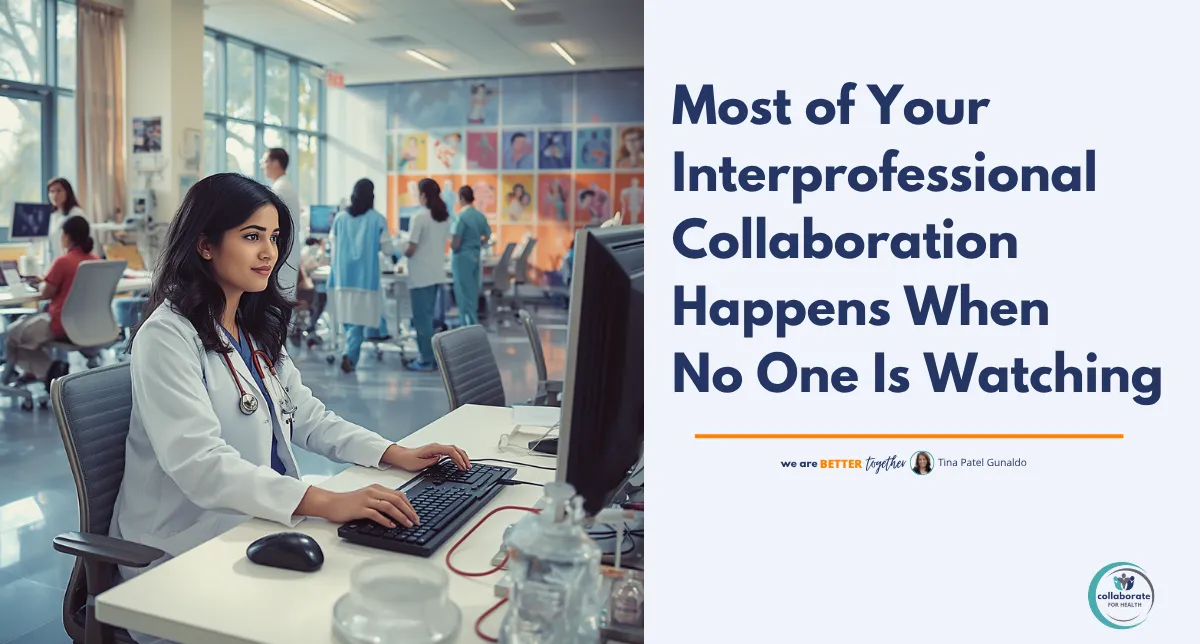
Most of Your Interprofessional Collaboration Happens When No One Is Watching
Interprofessional collaborative practice (IPCP) does not always look the way we picture it. Most of us picture a room full of people, a huddle, bedside rounds, or a meeting where everyone is present at the same time. That image is only a slice of what interprofessional collaborative practice really is. Much of it happens quietly, in individual actions, when no one else is in the room.
Understanding asynchronous interprofessional collaboration, the kind that happens outside of formal team meetings, is one of the most practical shifts a health professional can make in how they think about their everyday work.
What asynchronous interprofessional collaboration looks like
Consider a physical therapist who takes a blood pressure reading, not only because it aligns with the treatment they are providing, but because they understand that as a member of the interprofessional team they may be the first person to catch a high reading.
According to the Centers for Disease Control and Prevention, heart disease caused 683,491 deaths in the United States in 2024, making it the leading cause of death in the country. Many patients are not seeing a primary care provider regularly. The health professional who sees that patient today, regardless of their discipline, is accountable for more than the outcome within their own scope.
Consider a phlebotomist who, after drawing blood, lowers the bed, reminds the patient to ask for help before getting up, and places the call bell within reach, because they understand they are a member of an inpatient team working to prevent hospital falls. They could have finished the blood draw and left the room. They did not.
Neither of these examples looks like collaboration in the way we usually teach it or picture it. No one is gathered around a table. Each action is performed alone. Each one contributes to the work of the whole team.
What makes an everyday task interprofessional
The difference between an everyday task and IPCP is intention.
The physical therapist took a blood pressure reading that any number of people could take. The intention behind it, the understanding of what that reading means for the team and the patient, is what made it interprofessional collaborative practice. The phlebotomist's choice to lower the bed and place the call bell came from knowing they were part of a fall prevention team, not from a checklist.
Remove the intention, and these become tasks. Keep the intention, and the same actions become contributions to a shared outcome.
Interprofessional collaborative practice is not determined by the action. It is determined by the intention behind the action and the interprofessional understanding that drives it. A health professional cannot act with that kind of intention unless they have developed enough knowledge of other professions to understand when their actions connect to a shared outcome that extends beyond their own discipline.
That understanding is what interprofessional education (IPE) is designed to build. It is also why IPE is the training ground for interprofessional collaborative practice, not an add-on, but the preparation that makes moments like these possible.
What this means for how we design teams
When leaders understand that interprofessional collaboration is as much asynchronous as it is synchronous, the way they think about building collaborative teams expands. They stop waiting for the right meeting or the right room and start asking different questions.
Which of our everyday workflows carry an interprofessional intention? Which do not? Where could the design of our documentation, our referral processes, or our handoff protocols make it easier for each health professional to act as a member of the whole team, not just a contributor to their own piece of it?
These are the questions that move teams from parallel work toward integrated care. Joint Commission's 2024 Annual Review on Sentinel Events reported 1,575 sentinel events for the year, an increase of approximately 13 percent over 2023, with the leading categories together accounting for 85 percent of all reported events and most linked to communication breakdowns and protocol lapses. Most of those breakdowns do not happen in formal team meetings. They happen in the everyday moments between professions where intention was absent and design was never considered.
Where to go next
If you want to recognize and build on the interprofessional contributions already happening in your everyday work, two online course resources will help.
The first walks through the difference between multidisciplinary, interdisciplinary, and interprofessional teams, providing the foundation for understanding what makes an action genuinely interprofessional rather than simply professional work happening in parallel.
The second goes deeper into recognizing interprofessional collaborative practice in everyday clinical work, with real examples of asynchronous IPCP across practice settings.
For the foundational posts in this series on what IPE and IPCP actually are, start here.
What is Interprofessional Education?
What is Interprofessional Collaborative Practice?
Reach out if you are ready to talk about what this looks like inside your specific environment.
We are better together...and better does not happen by accident.
Visit collaborateforhealth.com

