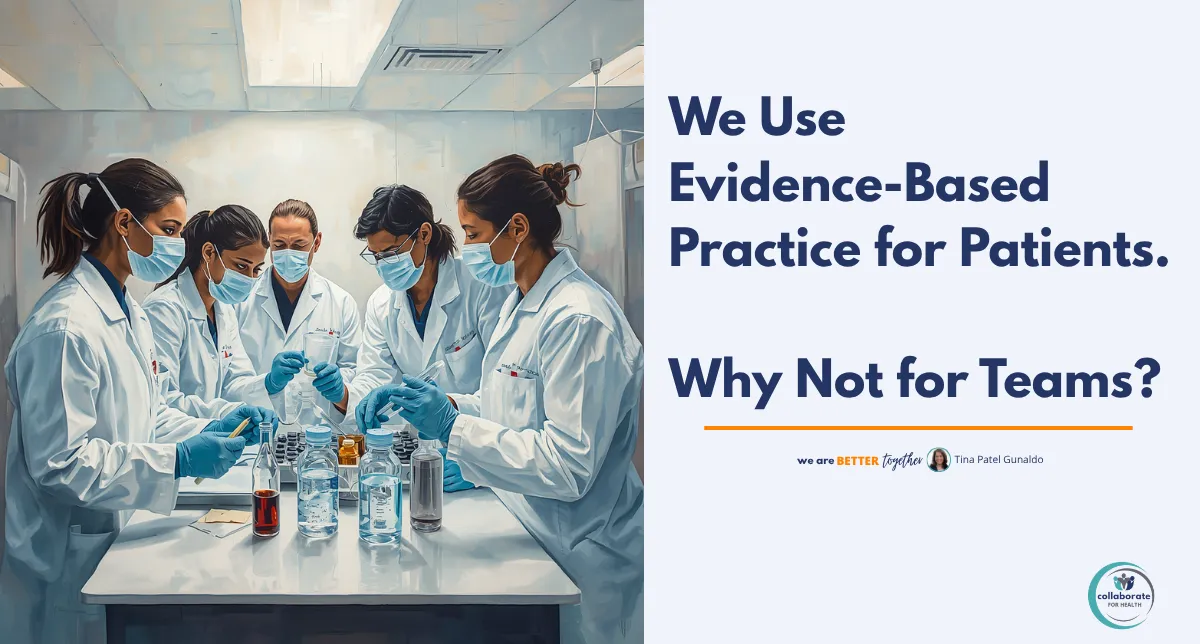
We Use Evidence-Based Practice for Patients. Why Not for Teams?
Healthcare does not guess when it comes to patient care. When someone presents with signs of a stroke, there is a protocol. Timing matters, interventions are clear, and outcomes depend on it. That same standard of applying evidence intentionally to how work is structured should apply to interprofessional collaborative practice (IPCP) and the teams we ask to deliver it.
We have decades of evidence in the science of teamwork, communication, and interprofessional collaboration. The question is why so few leaders are asked to apply it.
The standard we already hold for clinical care
As a leader, you expect clinical teams to integrate evidence-based practice into their workflows, because outcomes improve when care is grounded in research, clinical expertise, and the patient's perspective. That standard is clear.
When it comes to working in interprofessional teams or collaborating across departments, however, that same level of rigor is rarely applied. We know that shared goals, clarity of roles, intentional team design, and structured communication improve team performance. Knowing this and operationalizing it as a leader are not the same thing.
What the evidence on team design actually shows
When collaboration is designed using an evidence-informed approach rather than left to goodwill and effort, outcomes change. A 2019 study published in the Annals of Family Medicine examining an IPCP model implemented within a family medicine residency and ambulatory care center found that high-risk patients experienced 16.7 percent fewer emergency department visits, 17.7 percent fewer hospitalizations, a 0.8 percent reduction in hemoglobin A1c levels, and a 48.2 percent reduction in total patient charges. These results did not come from asking people to try harder. They came from designing how professionals worked together.
That is what applying evidence to team design produces. It is not a theoretical improvement. It is a measurable one.
The gap between knowing and leading
Your team's results are not only a reflection of their effort. They are a reflection of how the work is structured, and that structure is shaped by your leadership.
Most leaders were trained to manage performance within their department. They are simultaneously responsible for influencing system-level results. The gap between those two expectations is rarely addressed directly.
If you rely on instinct, past experience, or what you heard in a conference session about clarity or communication, that is not enough to produce consistent and sustainable system-level results across departments. This is not about your capability. It is about a gap in exposure to the science behind how teams actually function.
In clinical care, we would never expect outcomes to improve without understanding the evidence behind the intervention. Leadership should be no different.
Moving from concept to structure
If we expect teams to perform across professions and departments, leaders must understand the science that supports that work and integrate it into how they design workflows, roles, and accountability. This is where IPCP must move from concept to structure, and where cross-department collaboration must move from expectation to design.
Healthcare does not need more effort from teams. It needs leaders who understand the science of interprofessional collaboration and apply it intentionally to cross-department work to produce reliable, system-level results. This is the shift from managing a department to leading at the system level.
Where to start
If you have never been shown how to prepare and design collaboration across teams, the 6 Conversations That Prepare Teams for System-Level Work is the clearest starting point. It walks through the conversations most teams were never guided to have but need to have before interprofessional collaboration and cross-department work can succeed.
Download the 6 Conversations guide here.
For the foundational posts in this series on what IPCP is and how it is designed, start here.
What is Interprofessional Collaborative Practice?
When Healthcare Is Designed Around Departments.
Reach out if you are ready to structure collaboration more intentionally.
We are better together...and better does not happen by accident.
Visit collaborateforhealth.com

