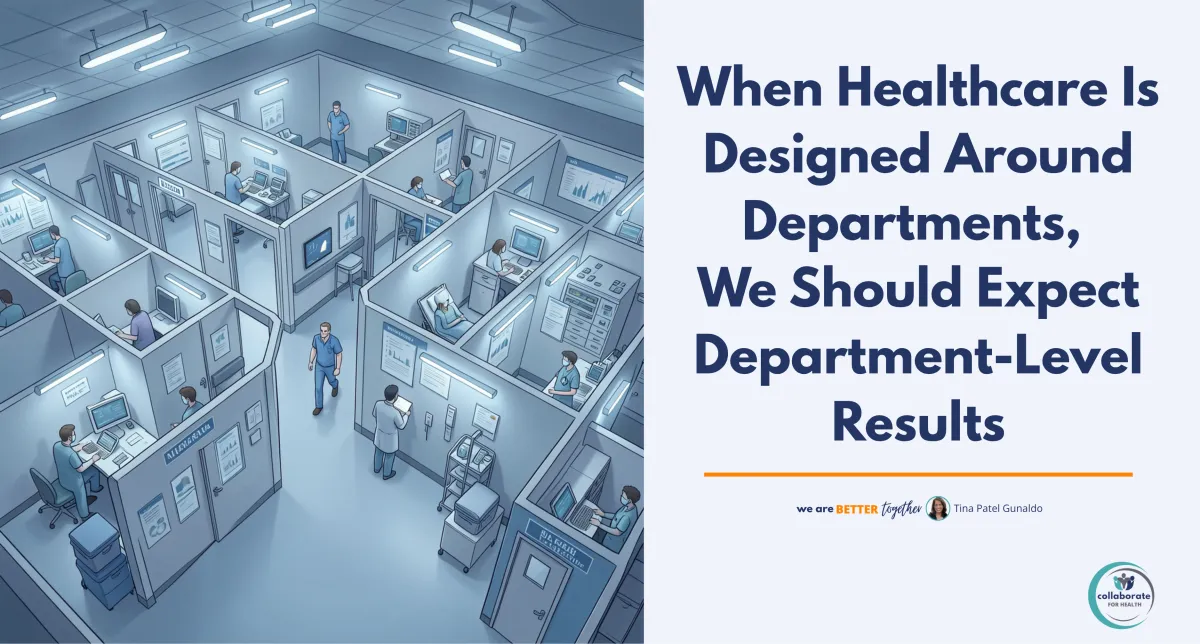
When Healthcare Is Designed Around Departments, We Should Expect Department-Level Results
Healthcare systems produce the outcomes they are designed to produce. When care is organized around professions and departments, departments become stronger and expertise deepens, but coordination across the system requires extra effort. That is not a people problem. It is a design problem.
Understanding why healthcare defaults to department-centered structures is the first step toward designing something different.
How professional formation shapes practice
When health professionals enter their programs, most of their education takes place alongside people in their own discipline. Nursing students learn with nurses, physical therapy students learn with physical therapists, and pharmacy students learn with pharmacists. Occasionally programs intersect, but the majority of professional formation happens within disciplinary boundaries.
Those patterns continue once professionals enter practice. Departments are organized around professions, teams are structured around disciplines, and sometimes even the physical layout of buildings reflects those divisions. Over time, this structure becomes normal. Over time, this structure becomes the expected way of working, reinforced by how budgets are built, how performance is measured, and how success is defined.
How patients experience the system
Patients often experience healthcare in much the same way. They schedule separate appointments to see their optometrist, dentist, primary care provider, audiologist, and other professionals. Each visit may be valuable on its own, but the system surrounding those encounters is often disconnected.
When a patient is relatively healthy, the person coordinating information across those visits is often the patient themselves. The system functions, but it does not always function as a coordinated whole. According to the World Health Organization, approximately 1 in every 10 patients is harmed in health care, and more than 3 million deaths occur annually due to unsafe care. These outcomes do not emerge from a single department or profession failing independently. They emerge in the spaces between professions, in the handoffs, coordination gaps, and communication breakdowns that accumulate when care has never been intentionally designed to connect.
How leadership structures reinforce silos
Department leaders frequently experience similar dynamics. They are asked to manage staffing, develop budgets, and improve performance within their department, while also contributing to broader organizational initiatives. The primary focus, however, often remains departmental success.
Very few leaders are asked to develop budgets across departments or redesign workflows that intentionally span professions. The structure itself limits the scope of what leaders are expected to solve.
The challenges healthcare organizations face, quality improvement, care transitions, access to services, and workforce sustainability, rarely belong to a single department. They live in the spaces between departments, between professions, and between the handoffs no single leader owns.
What interprofessional collaborative practice offers
Interprofessional work recognizes that patient needs rarely fit neatly inside one professional boundary. Care moves across professions, departments, and services throughout the patient journey.
When collaboration is intentionally structured across professions, leaders begin to shift from managing departments to designing how teams work together. Instead of asking where their department performs well, system-level leaders begin asking where the patient journey moves between professions, where shared workflows could replace fragmented handoffs, and where accountability should follow the patient rather than the department.
These are the questions that move organizations from department-centered structures toward coordinated systems of care.
Why this matters for healthcare leaders
Department leadership remains essential. System-level results, however, require leaders to see beyond their own boundaries. When leaders begin designing shared workflows and shared accountability, collaboration becomes easier to sustain. Not because people are trying harder, but because the system now supports the way care actually happens.
The central question for any leader thinking about system-level outcomes is where might collaboration need to be intentionally designed so the system can produce different results?
That question is where interprofessional collaborative practice begins.
Where to go next
If you are newer to the concepts of interprofessional education and interprofessional collaborative practice, the following posts in this series provide the foundation.
What is Interprofessional Education?
What Interprofessional Education Is Not.
What is Interprofessional Collaborative Practice?
What Interprofessional Collaborative Practice Is Not.
For a deeper foundation in how to recognize and design interprofessional collaborative practice in everyday work, the IPCP in Everyday Work video walks through real examples from practice.
Access the IPCP in Everyday Work video here.
Reach out if you are ready to talk about what this looks like inside your specific environment.
We are better together...and better does not happen by accident.
Visit collaborateforhealth.com

