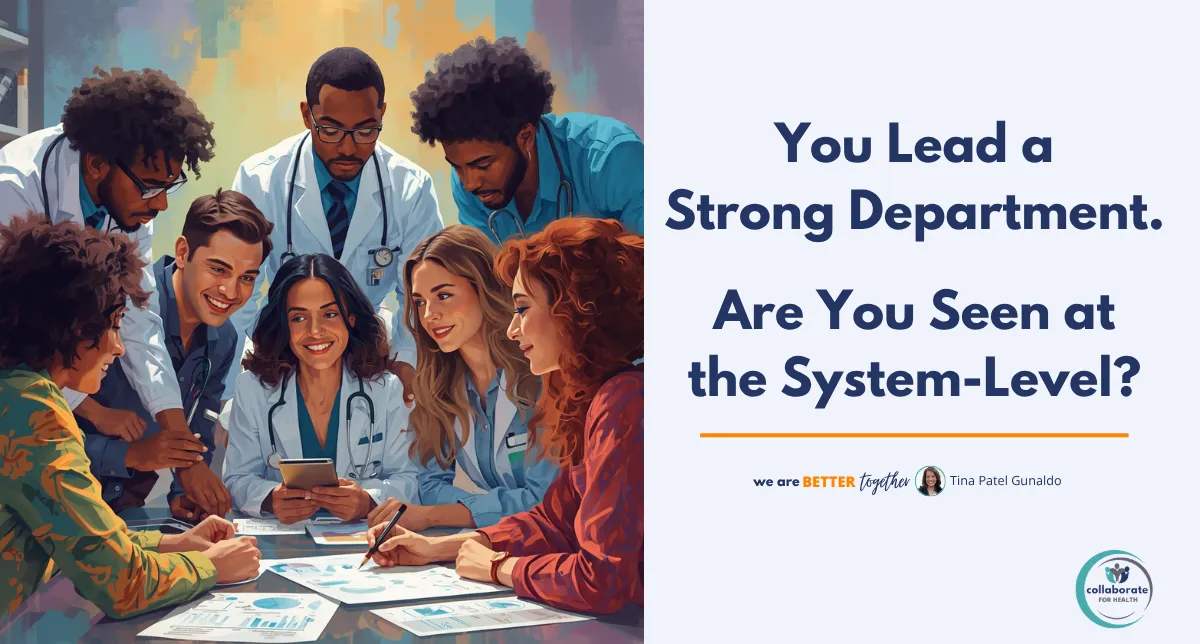
You Lead a Strong Department. Are You Seen at the System Level?
How to Prepare Your Team for Cross-Department Work in Healthcare
When cross-department collaboration breaks down in healthcare, the first instinct is to schedule more meetings or ask people to communicate better. Neither tends to work, because the breakdown usually started before anyone came into the room.
If you are a department-level leader trying to move your team toward system-level work, the preparation that happens before collaboration begins matters more than most people realize. This is where the gap lives between departments that coordinate and departments that actually move the system.
Why working harder inside your department stops working
Healthcare leaders are being asked to solve problems that do not live inside one department: access, care coordination, falls, health equity, and hospital-acquired infections. These are interprofessional and cross-department challenges by nature, and they require leaders who can do more than manage their own area well.
The scale of that challenge is significant. The World Health Organization reports that approximately 1 in every 10 patients is harmed in health care, and that more than 3 million deaths occur annually due to unsafe care, with approximately 4 in 10 patients harmed in primary and outpatient settings, and up to 80 percent of that harm considered preventable. These outcomes are not produced inside a single department. They emerge in the spaces between professions, between teams, and between the handoffs no one has designed carefully enough.
Department teams working on these problems often run into predictable friction. Team members arrive with different definitions of success, different assumptions about roles, different perspectives on which outcomes belong to whom, and different levels of understanding about how their department's work connects to another's. That friction is not a personality problem. It is a preparation problem.
This is where motivated department leaders start working harder and seeing less return. The effort is real. The structure for making it effective has not been built.
What strong leaders do before the work begins
The leaders who successfully move their teams into cross-department and system-level work do something that is easy to overlook: they prepare their teams before the collaboration begins, not after it stalls.
That preparation is specific. It creates space for the team to understand what the work means beyond their department, how their role connects to a shared outcome, what collaboration will require of them specifically, where accountability is shared rather than individual, and how success will be defined in terms the whole system can see.
When a leader builds that foundation, the conversation inside the team shifts. The focus moves from "my role in this care" to "our shared responsibility for this outcome." That shift is what makes cross-department work sustainable rather than dependent on one leader pushing it forward every time.
Joint Commission identified ineffective communication as the root cause of nearly 66 percent of all reported sentinel events between 1995 and 2005, and communication remained among the top three root causes in subsequent reporting periods. The conditions that produce those communication failures rarely start in the moment of the breakdown. They start earlier, in the absence of shared language, shared accountability, and intentional preparation. Leaders who build those conditions before the work begins are doing more than improving collaboration. They are demonstrating they can lead at the level the next role requires.
What this preparation signals to decision-makers
When you prepare your team this way, your leadership becomes visible in a different way. You stop being seen only as someone who manages a department. You start being seen as someone who can connect the system, set conditions that allow different professions to work together well, and produce outcomes that are visible beyond your own area.
That visibility is what advancement requires. Decision-makers are not looking for leaders who manage one area effectively. They are looking for leaders who can shape how the whole system moves.
If you have been thinking that you are ready for the next role, you may not need more experience. You may need a different starting point: the conversations that happen before the cross-department work begins.
Where to start
The 6 Conversations That Prepare Teams for System-Level Work was built specifically for this. It walks department-level healthcare leaders through the conversations most teams were never guided to have, but need to have, before interprofessional collaboration and cross-department work can succeed.
Download the 6 Conversations guide here.
Through Collaborate for Health, I help motivated healthcare supervisors, managers, and directors apply interprofessional collaboration principles to prepare, design, and sustain cross-department work that creates measurable impact and increases their visibility as system-level leaders.
We are better together.
Visit collaborateforhealth.com

