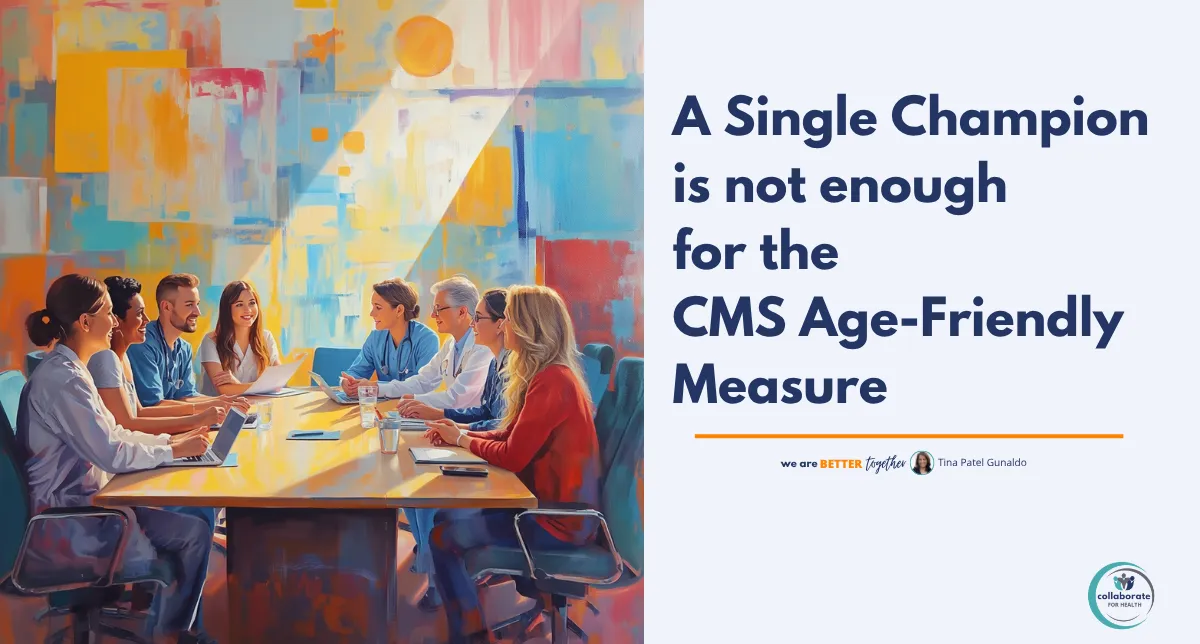
Why a Single Champion Is Not Enough for the CMS Age-Friendly Hospital Measure
The Centers for Medicare and Medicaid Services (CMS) added the Age-Friendly Hospital Measure to its Hospital Inpatient Quality Reporting Program in 2024, through the fiscal year 2025 Inpatient Prospective Payment System final rule. To attest to the measure's leadership domain, CMS asks a hospital to designate a champion or an interprofessional committee to prioritize age-friendly care, compile the related quality data, and use that data to drive improvement.
I am leading this measure within our health system, and the choice between those two options was not a difficult one. Age-friendly care cannot be designed by a single profession, or carried by a single champion. It reaches across too many areas of expertise to belong to any one person.
What Does the CMS Age-Friendly Hospital Measure Require for Leadership?
CMS built the Age-Friendly Hospital Measure around five domains, and those domains sit on top of the 4Ms framework: What Matters, Medication, Mentation, and Mobility. Leadership is one of the five domains, and it is the domain that determines who is accountable for the other four.
For the leadership domain specifically, CMS asks a hospital to designate a point person or an interprofessional committee, and either option satisfies the requirement. The designee or committee is expected to oversee age-friendly care priorities, keep hospital leadership informed, and compile the quality data that shows whether the work is producing results.
Why Is a Single Champion Not Enough?
The World Health Organization (2010) defines interprofessional collaborative practice (IPCP) this way: "Collaborative practice happens when multiple health workers from different professional backgrounds work together with patients, families, carers and communities to deliver the highest quality of care across settings." A single champion, however capable, still practices from one professional lens. Eliciting what matters to a patient calls on different expertise than screening for frailty. Screening for frailty calls on different expertise than managing medication or assessing social vulnerability. One person can champion the initiative. One person cannot hold all of that expertise at once.
CMS pointed toward an interprofessional approach when it built the measure this way, and that word choice matters. An interdisciplinary or multidisciplinary team can still divide its work so each profession stays in its own lane. The difference between multidisciplinary, interdisciplinary, and interprofessional teams is not a matter of semantics. It shapes what the team can actually accomplish. An interprofessional committee is built to hold shared accountability for outcomes that no single profession owns alone, which is what IPCP requires.
Building the Committee: What We Did
We built a committee, bringing together professions for the specific expertise each one held. From there, we created working groups within the committee, each responsible for one domain of the measure. Between meetings, each group carried its work forward, and when they returned, the rest of us trusted what they brought, because they held expertise we did not.
I am proud of this team, and the work is moving forward.
Where to Start If You Are Leading a Similar Initiative
The Age-Friendly Hospital Measure is one example. The same design decision applies to any initiative that depends on professions working as one: a readmissions committee, a discharge planning workgroup, a falls prevention team. Before you name a single champion, ask who else the outcome actually depends on. Where should leaders start when designing cross-department collaboration is a question worth answering before the committee is built, not after.
If you are leading an interprofessional initiative, an Age-Friendly Hospital Measure team, or any effort that depends on professions working as one, reach out if you are ready to talk about what that could look like inside your organization. If you want a starting point first, the System-Level Leadership Diagnostic is a free way to see where your team stands before you build the committee.
We are better together...and better is intentionally designed.
Visit collaborateforhealth.com

